Valuation of PKO BP shares based on comparison of the results of retail banks already quoted at the Warsaw Stock Exchange is an unfair solution. Obviously, the value of a company depends on estimation of its future profits. Opinions about PKO BP being expensive compared to other retail banks as its P/E ratio is x% higher than the average in the banking industry can indeed tell us something – but about the authors of such an estimate. The most down-to-earth remark that may be offered here is that an average tells you nothing, as usually the above average P/E ratio marks companies whose future results turn higher than average, too. And, by the way, would the estimation process be interesting at all if it boiled down just to comparing P/E?
Why does PKO BP exist? And other banks as well…
The answer is contained within the bank’s name: the abbreviation stands for POWSZECHNA Kasa Oszczędności (COMMON Savings Treasury). The company holds a tremendous advantage of scale compared to its competitors, and the economies of scale is an effect that cannot be disregarded when talking about a retail bank. You would find no type of activity in which PKO BP does not take advantage of its market leadership. The costs of management, computing network development, promotion, marketing etc are shared by more customers. Each action that PKO BP undertakes is relatively cheaper than the deeds of its competitors.
The specifics of the retail banking
industry provides another kind of advantage from the economies of scale. For
example, the cost of bank transfers for a customer is usually lower when talking
about internal transfers, and often reduced to zero. Moreover, if money is
transferred within one bank, it reaches the account of destination instantly,
without need to wait for the settlement sessions.
A great number of accounts ran by PKO BP effects in people having their accounts
elsewhere will be forced by their own business surroundings to open one with PKO
BP as well. And the company being a prevailing account provider is true not only
among businesses, but among individual customers as well.
PKO BP
needs no special promotion of its accounts, while the best promotional tool is
the fact that such accounts are so widespread, with the majority of market
players having their accounts precisely with this bank. Hence, companies
frequently doing business involving money settlements, even more so if the
settlements involve individual customers, would possess an account with PKO BP
in order to remain competitive. And the higher market share the bank has, the
easier it may increase it further by attracting new customers who respond to the
needs of their environment. Those new customers would create the need of opening
an account in a following group of prospects, and so on. The Polish
anti-monopoly regulations are not a threat here, with a 50% market share being
critical, compared to just twenty-and-some in Germany. Another example of
differing regulations may be British Petroleum forced to sell some of its gas
stations constituting a 4% market share in order for the resultant market share
not to exceed 22%. And, in fact, the like share on the retail banking market
provides more power, due to different product specifics (and lower elasticity)
than in the case of gas stations.
There is no use in trying to reproach the PKO BP clients for choosing this
particular bank. Charging high rates for keeping the account or for transfers is
not in the best interest of the bank, as the first thing that counts is the
scale, where a small unit profit is backed up by high volume of turnover. As a
second thing, extra profits are guaranteed by other products, with an account
being a bait to attract the customer. The anti-monopoly bureau has, as we see,
just a minute chance to contain PKO BP.
The Polish banking system consists of PKO BP and other
banks. Those other banks may not like it; they may not perceive the power of
PKO BP as well. But just like in the case of PZU the strength and value of PKO
BP do not stem from the results recorded so far, but rather from the future
profits. The insurance market and the retail banking market alike are going to
grow much faster than the GDP.
The PKO BP bank has huge room for growth due to expansion of the market and the
economies of scale. Hence its value is many times higher than the one resulting
from estimation based on historical financial record data. The economies of
scale are perceived really well by the anti-monopoly officials in Germany, but
on the domestic market PKO BP will be unstoppable by the anti-monopoly bureau.
It will intercept other banks’ customers with an ease of a running avalanche. Or,
to say it in other words: you can have any bank account you want in Poland,
provided that it is a PKO BP account.
So here we have one issue of the market share that PKO BP has and the resulting economies of scale, with another issue being the size of the market. The value of banking services is still many times lower in Poland than it is in the countries of the EU-15, and so are the personal debt levels, both face value and compared to annual income. The retail banks will feel the results of an economic warm-up later than the ones servicing large and medium businesses, but then those are precisely the retail banks whose profit out of the warm-up will be the greatest. The industrial market is much more competitive, whereas the retail banks, especially the largest ones, just take advantage of their sales networks. For private customers and small businesses the basic criterion for choosing the bank is the access to it through an account, and not the differences in interest rates or commission values. PKO BP has a broad depository base, which means access to cheap money. In the future the other side of the equation – increase in credit base – will be provided as well, and this will be the less demanding (and more common) part of credits for small businesses and private customers.
PKO BP includes an offer for the up-market customers as well. Internet banking accounts are offered to all the account holders, with PKO BP suddenly having become the largest internet bank in the country. Still few of the PKO BP customers are using this option, but those who want it, do have such an option. This is a profitable combination indeed!
CA IB report on PKO BP – a ‘miscarriage of valuation’?
A few days ago, CA IB issued a report determining the value of a PKO BP share to be 21.7 PLN. It is a common knowledge that CA IB is a strange bank in a sense, having become famous by means of HOOP S.A. and IMPEL S.A. offerings and valuations. In both the cases mentioned, the bank, being at the same time the offerer, has grossly overestimated share values. Taking into account the upturn in index values, the overestimation was as high as 200%, which means that for the CA IB valuations to be true the HOOP and IMPEL shares would have to be three times as expensive as in reality! There is more to read about CA IB in an editorial from Rzeczpospolita: http://polandsecurities.com/ca-ib.html
Now it
seems that CA IB in turn grossly underestimated the value of PKO BP, which is
being indicated by the market. A ‘miscarriage of valuation’? Ones adverse to the
company claim something different.
The Ministry of Treasury is being criticized for how the privatization of PKO BP
was conducted. The charges of having sold PKO BP at a price much lower from the
one that could have been obtained start to be justifiable. Moreover, the
Minister of Treasury admitted that “social causes” did influence the price. More
about the PKO BP privatization:
http://polandsecurities.com/pko.htm
The Ministry let a multitude of petty investors profit. In fact, the ones that
both had some ready cash and queued to get the scarce good – with the queues
taking after ‘social list’ and rationed sale – did profit. The ones that
possessed PKO BP – that is the whole society – lost. The ones that earned at the
cost of all others were the people queuing in front of the bank branches (which
is not a derogatory remark – they have acted in a really rational way, on a ‘if
they give – take it’ basis), stockbrokers and banks charging commission on loans
provided to make up for predicted reductions. Good entertainment for public
money… The way PKO BP was privatized is depicted best with a single question: a
sabotage or mere foolishness?
And then the CA IB report appears, evaluating the PKO BP
shares to be worth 21.7 PLN in line with the Minister’s opinions. At the same
time, the CA IB Financial Advisors Sp. z o.o. and CA IB Securities S.A. are
invited to place bids for a limited tender designed to choose an Advisor to the
Ministry of Treasury for PZU S.A. privatization. The CA IB CEO, Ms Alicja
Kornasiewicz, has already privatized PZU once… Apparently together with Minister
Socha she wants to move forward this “successful” privat(e)-ization.
CA IB concluded a deal with PZU recently, resulting in at least a 100m PLN loss
on the side of PZU according to opinions of analysts and investment advisors.
The market was shocked by the underrated total for a purchase of shares of three
NFI (National Investment Funds). You can read more about the transaction in and
editorial from Parkiet:
http://polandsecurities.com/raport/pzu As a reward, CA IB was invited to
place a bid in a tender to appoint an advisor to deal with the PZU privatization.
The Ministry’s actions could be called grotesque if it was not for the fact that,
that the whole society has to pay for such “entertainment”, including people
much less opulent than Ms. Kornasiewicz or Mr. Socha. An invitation to CA IB
regarding the deal with PZU should indeed have been issued – but and invitation
to the prosecutor’s office.
The stock market environment sometimes witnesses deals that
are widely named ‘white collar crimes’. Yet sometimes such crimes happen, that
could be nicknamed ‘snatch-and-run deals’ as well.
And an accusation of such a crime is more than relevant in the case of PZU and
CA IB deal.
Apparently, Ms Alicja Kornasiewicz will not disclose any more information on the
details of deal with Eureko and the attempt to sell control of PZU for a
fraction of its value and against the tender procedures until the Judgment Day.
The environment should, nevertheless, eliminate people suspected of deals
resulting in damage to the Treasury, even more so when credibility of such a
person and the organization that he or she leads slumps and public
recommendations issued by it indicate at the very least lack of knowledge in the
area of company valuation.
Jacek Socha is apparently trying to continue the Eureko mega-deal, and as he
invites Ms. Kornasiewicz to cooperate, he fails to see anything suspicious in
the CA IB and PZU deal (or, if he saw something, he chose not to boast about
communication with the prosecutor’s office).
PKO BP value
Taking
into account the law restrictions on compiling recommendations here I will quote
the opinions of some investors I know. The think that, considering prices of
other banks quoted on the stock exchange, the value of PKO BP shares is about 40
PLN. Such price rate represents the fair value of the bank. I share their
opinion fully.
The estimate regards current bank share prices. If those prices of retail banks’
shares increases, the estimate should be elevated as well. Approximately, a fair
value of PKO BP would be 40 PLN + or – the change in the WIG Banki index.
The regulations regarding compilation of free reports came into being right
after the HOOP SA IPO, when the Commission for Securities and Stock Exchange
reproached a practice of issuing reports critical towards the company about to
go public. The issuers’ reports provided estimates of HOOP SA value much above
the IPO price (provided by CA IB, DI BRE Bank and JPMorgan). The only
independent report, written by me, having resulted in rescheduling the IPO,
valued the shares according to the company book value. It considered the other
estimates, a few times higher than the book value, to be irrelevant. Currently,
the value of HOOP SA is indeed oscillating around the book value per share.
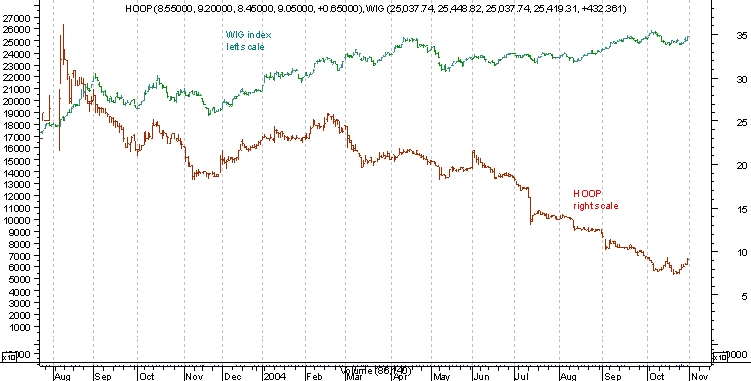
The people who believed the CA IB and DI BRE Bank reports and paid 4 time the
book value per share have apparently lost. Here is a chart presenting HOOP SA
quotations:
http://polandsecurities.com/hoop-vs-wig.jpeg
A side story on TVN
Currently, such companies as CA IB,
BRE Bank and JPMorgan are linked to the TVN SA share issue. The ITI Holdings
owners, including BRE Bank, will record income from the shares sold.
At the same time, the ITI founders and financial shareholders support an
elevated valuation of TVN, being the main asset of ITI. Not only do they hold
TVN and ITI shares, but also… TVN and ITI debts.
A bankruptcy of TVN would affect the portfolios of a few friendly entities by an
amount of several billion PLN, standing for the paper valuation of TVN and ITI
shares as well as debts of both companies. That is why one should say that the
TVN shares sold in the IPO or simply moved ‘from one portfolio to another one’.
Most probably, adverse conditions meaning lack of demand on the side of private
investors would result in purchase of shares by friendly entities. Swapping the
shares like this costs nothing and provides an opportunity to create any kind of
a ‘market’ price the participants want. Due to higher necessity (the need of an
‘appropriate’ valuation of TVN) small investors, being the ones who responded
best to the IPO, still have a chance to quit their commitment. Here you will
find more about TVN
http://ipo.polandsecurities.com/tvn-ipo.pdf [in English]
One should remember that bubbles grow really nice, but then they burst in an
even more fashionable manner, and it is the public, not financial institutions,
that are lured by small amounts of air-filled soap, very often broadly
advertised ahead of an IPO.
We might recollect, to be precise, that Hoop, sold for 21 PLN during the IPO,
reached the price 35 PLN during the first few sessions at the Warsaw Stock
Exchange, and as much as 100 PLN much earlier when quoted at the Central Table
of Offers, while the current quotations are just about 9 PLN.
Another interesting detail of the last days linked to the BRE Bank portfolio, is
the forecast of bleak results of Q4 2004 by the BRE Bank. One would rather
expect a huge improvement of a credit portfolio and capital investments
resulting from the general warm-up of the economy, with such a forecast
indicating best the kinds of treasures that BRE Bank possesses.
Sidewise, the way of realizing the asset value is a plainly strange thing here.
One would expect the assets to be monitored on a current basis, as required by
the banking law, but also by basic principles of bookkeeping. If those assets
lost their fair value in another quarter, the results of it had to be, at least
to say, not too true. Do the assets of BRE Bank really lose their value during
economy warm-up, then?
Jaroslaw Suplacz
29.12.2004
Adres Redakcji i Wydawcy:
ul. Szarych Szeregów 18/20, 09-409 Płock
Redaktor naczelny i Wydawca:
Jarosław Supłacz
Miejsce i data wydania:
Płock, 29.12.2004